
Corrosion Protection Mechanism
BTA (Benzotriazole) is a well-known corrosion inhibitor for copper and copper alloys.
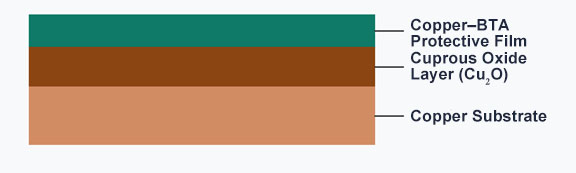
The nitrogen atoms within the triazole ring coordinate with cuprous ions (Cu(I)) and cupric ions (Cu(II)) on the copper surface, forming a stable coordination complex known as the Cu-BTA protective film.
In humid environments or systems containing chloride ions, this protective layer covers the copper oxide surface and helps prevent direct contact between the metal and corrosive agents such as oxygen, moisture, and chloride ions, thereby reducing oxidation and corrosion of the copper substrate.
Concentrated Anti-Corrosion Solution for Copper Wire Drawing
During copper wire drawing operations, including coarse, intermediate, and fine wire drawing processes, direct addition of BTA powder into cold water systems may result in precipitation due to its limited water solubility.
For this reason, a concentrated anti-corrosion solution is typically prepared first and then added to the wire drawing fluid.
Reference Formulation (100 kg)
| Material | Recommended Amount | Function |
|---|---|---|
| BTA (Benzotriazole) | 10–15 kg | Primary corrosion inhibitor |
| Triethanolamine (TEA) | 30–40 kg | Solubilizer and pH adjuster |
| Ethylene Glycol or Isopropanol | 10–15 kg | Co-solvent |
| Deionized Water | Balance | Solvent base |
The above formulation is provided for technical reference only. Actual formulations should be adjusted according to specific production requirements and operating conditions.
Preparation Procedure
- Add triethanolamine (TEA), ethylene glycol, and part of the deionized water into a mixing vessel.
- Start agitation and heat the mixture to 50–60°C.
- Gradually add BTA powder while stirring.
- Continue mixing until the solution becomes completely clear and free of undissolved particles.
Operational Control in Wire Drawing Processes
• Dosage and Replenishment
The effective BTA concentration in the wire drawing fluid system is recommended to be maintained at 0.05%–0.20% (500–2000 ppm).
When using a prepared concentrate, an addition level of 0.5%–1.5% based on the total volume of the wire drawing fluid is generally recommended.
During operation, BTA may be carried out with the copper wire or gradually consumed through its protective action. Therefore, regular monitoring and weekly replenishment are recommended.
• pH Control (8.5–9.5)
An alkaline environment helps maintain BTA in a stable dissolved ionic state, allowing optimum formation of the protective film.
If the pH falls below 7.0, BTA may precipitate from the solution, resulting in reduced corrosion protection performance.
• Operating Temperature Control (40°C–50°C)
The wire drawing fluid temperature is recommended to be maintained between 40°C and 50°C.
Excessive temperatures (> 60°C) may accelerate emulsion breakdown and increase consumption of the corrosion inhibitor, while excessively low temperatures may adversely affect lubricant flowability and lubrication performance.
• Annealing Tank Application
For wire drawing lines equipped with a Continuous Annealer, it is recommended to add 0.05%–0.10% BTA aqueous solution to the annealing condensation water tank.
A small amount of Triethanolamine (TEA) may be used as a solubilizing aid.
This treatment helps prevent freshly annealed hot copper wire from rapidly oxidizing, discoloring, or developing red or black oxide stains when exposed to high-temperature moisture.
Bare Copper Immersion Test (Laboratory Evaluation)
The Copper Development Association references two immersion treatment conditions: the Brass Handbook recommends 0.20 wt%, while the Copper Alloy Technical Manual recommends 0.25 wt%. Both conditions specify an immersion temperature of 60°C and an immersion time of 2 minutes.
For the initial laboratory evaluation, a 0.20 wt% BTA solution is recommended.
wt% (weight percent) refers to the percentage of BTA by weight relative to the total weight of the working solution.
Example Formulation for a 0.20 wt% Working Solution
| Total Working Solution | BTA Required | Deionized Water |
|---|---|---|
| 100 g | 0.20 g | 99.80 g |
| 1 kg | 2.00 g | 998.00 g |
| 5 kg | 10.00 g | 4,990.00 g |
Laboratory Evaluation Procedure
1. Preparation
Prepare a balance, beaker, stirrer, thermometer, timer, sample holder, and waste collection container.
Review the Safety Data Sheet (SDS) before handling the material. During weighing and solution preparation, appropriate local exhaust ventilation, splash-resistant safety goggles, and suitable protective gloves are recommended.
2. Dissolution
Slowly add the weighed BTA into deionized water while stirring and heating.
Ensure that all crystals are completely dissolved and verify that the solution temperature reaches 60°C using a thermometer.
For this evaluation, water alone may be used as the solvent.
3. Copper Sample Cleaning
Select a bare copper specimen free from obvious oxidation or verdigris contamination.
Remove oil and contaminants according to existing plant procedures, thoroughly rinse away any cleaning agents, and handle the test area with suitable fixtures or holders.
4. Immersion
Completely immerse the area to be treated in the 60°C solution for 2 minutes.
If protection is required only on sections that will be overmolded or covered with PVC, the electrical contact area may be left above the solution surface during the initial trial.
5. Rinsing and Drying
For this laboratory evaluation, rinse the specimen with clean water for approximately 10 seconds, then allow it to drain and dry thoroughly.
The 10-second rinse time is referenced from copper-coated specimen studies; however, neither of the above immersion-treatment references specifies a mandatory rinsing duration.
For stranded wire samples, a section may be opened and inspected to confirm that the interior is completely dry before subsequent processing.
Record the actual solution temperature, pH value, preparation date, and immersion time. For the initial evaluation, use the water-based formulation as prepared and maintain the original pH value to facilitate comparison with future test results.
Further Reading
Related Keywords:
- BTA (Benzotriazole)
- Copper Corrosion Inhibitor
- Copper Anti-Tarnish Additive
- Copper Protection Chemical
- Wire Drawing Fluid
- Copper Wire Drawing
- Metalworking Fluid
- Copper Surface Protection
For more information about BTA-based copper protection additives, please refer to JUYEE BT Copper Corrosion Inhibitor product information.